Little Easter Bunny: A Practical Review for Seasonal and Educational Design
In the landscape of digital typography, finding a font that balances whimsy with professional usability can be a challenge. Many display fonts sacrifice legibility for style, or conversely, lack the character needed to truly engage an audience. Little Easter Bunny enters this space as a distinct option designed specifically for contexts requiring playfulness without sacrificing authenticity. This chunky lettered font embodies a sense of fun that feels genuine rather than forced, making it a viable candidate for designers, educators, and small business owners looking to add a touch of seasonal charm or childhood wonder to their projects.
The primary strength of Little Easter Bunny lies in its immediate visual impact. It is not merely a decorative typeface; it is a functional tool intended to evoke specific emotions associated with springtime celebrations, children's activities, and educational environments. For professionals working on school projects, party invitations, or marketing materials for youth-oriented brands, the ability to instantly convey a lighthearted tone is invaluable. The font's design philosophy centers on accessibility and joy, ensuring that the message remains clear while the aesthetic invites engagement.
Visual Characteristics and Design Philosophy
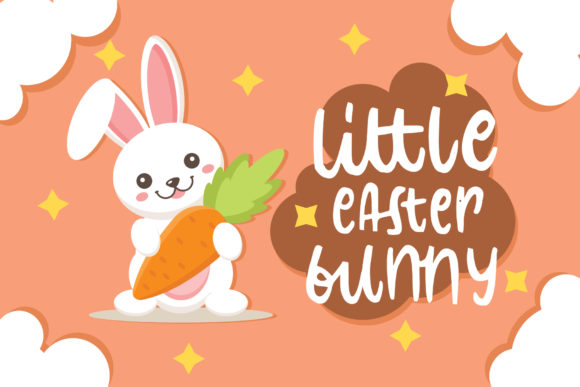
At first glance, Little Easter Bunny presents itself as a robust, rounded typeface. The letterforms are thick and substantial, often referred to as "chunky," which gives them a tactile quality. This weight ensures that the text remains highly readable even at smaller sizes or when used on low-resolution displays. Unlike thinner script fonts that can become illegible when scaled down, the structural integrity of Little Easter Bunny allows it to hold its shape effectively across various media formats.
The authenticity of the font comes from its irregularities. While it maintains a consistent baseline, the slight variations in stroke width and the playful curves mimic the hand-drawn nature of illustrations found in storybooks. This prevents the design from feeling sterile or overly manufactured. For marketers and creators who want their content to feel personal and approachable, this human element is crucial. It bridges the gap between digital precision and the warmth of traditional crafts.
Furthermore, the font is engineered to stand out. In a feed dominated by minimalist sans-serifs and sleek modernist layouts, a font like Little Easter Bunny acts as a visual anchor. It draws the eye immediately, making it an excellent choice for headlines, pull quotes, or call-to-action buttons where attention is the primary currency.
Technical Specifications and Accessibility
One of the most significant practical advantages of using Little Easter Bunny is its technical encoding. The font is PUA (Private Use Area) encoded. For the uninitiated, this might seem like a minor technical detail, but for a designer, it represents a major workflow improvement. Standard fonts often limit the availability of alternate glyphs, swashes, or special characters unless they are explicitly mapped in the system's Unicode table.
With PUA encoding, users gain direct access to a comprehensive library of glyphs and swashes through specialized software interfaces or keyboard shortcuts. This means you can easily access decorative elements, alternative letter forms, and festive ornaments without needing to hunt through complex font editors or rely on third-party plugins. This ease of access ensures consistency in your design files and reduces the time spent formatting text manually. Whether you are creating a complex layout for a classroom bulletin board or a multi-page brochure for a local event, having all assets readily available streamlines the production process.
Practical Applications in Professional Workflows
While the name suggests a narrow niche, the utility of Little Easter Bunny extends well beyond just Easter-themed decorations. Its versatility makes it suitable for a wide range of applications where a friendly, inviting tone is required.
- Educational Materials: Teachers and curriculum developers can utilize this font for worksheets, flashcards, and reading primers. The chunky letters help young learners distinguish between characters, aiding in early literacy development.
- Event Planning: From birthday parties to community festivals, the font adds a celebratory flair to invitations, banners, and signage. Its readability ensures that critical information like dates and times is never lost amidst the decoration.
- Small Business Branding: Entrepreneurs selling children's products, toys, or organic treats can use this font to establish a brand identity that feels safe, trustworthy, and fun.
- Digital Content Creation: Bloggers and social media managers can employ Little Easter Bunny to create eye-catching thumbnails and headers that increase click-through rates among family-oriented demographics.
In each of these scenarios, the font serves a dual purpose: it communicates information clearly while simultaneously setting the emotional context of the project. This duality is what separates effective typography from mere decoration.
Performance in Real-World Scenarios
When evaluating the reliability of any font, one must consider how it performs under pressure. Does it break when kerning is adjusted? Does it look pixelated when printed on high-quality paper? Little Easter Bunny generally demonstrates strong performance in both print and digital environments. The vector-based nature of the file ensures crisp edges regardless of scaling.
However, there are limitations to keep in mind. Because the font is so stylistically heavy, it is not suitable for body text in long-form articles or formal documents. Using it for extended paragraphs would likely cause reader fatigue and reduce comprehension. The font is best utilized as a display element—used sparingly to highlight key concepts, titles, or short phrases. Professionals should treat it as a spotlight rather than a floodlight.
Additionally, the PUA encoding requires that the recipient of the design has the necessary software to render the special glyphs correctly. If a client sends a PDF created with Little Easter Bunny to a printer who does not have the font embedded or installed, the output may revert to a default fallback font, ruining the intended design. Always ensure that fonts are embedded in final deliverables or converted to outlines before sending files for external production.
Evaluating Long-Term Value and Suitability
For freelancers and agencies, the question of long-term value is paramount. Is Little Easter Bunny a fleeting trend, or is it a staple asset worth investing in? Given the cyclical nature of holidays and the perennial demand for children's content, this font offers enduring relevance. The themes of spring, renewal, and childhood are timeless, meaning designs created today will likely remain appropriate for years to come.
The font also supports a flexible workflow. Because it includes swashes and alternate glyphs, designers can create unique variations of the same word without changing the core typeface. This consistency helps maintain brand coherence while allowing for creative expression. For example, a logo featuring the font can be adapted for different seasons or campaigns simply by swapping out the swash elements, saving time on rebranding efforts.
It is important to note that while the font is authentic in its execution, it should be paired thoughtfully with other typefaces. Pairing Little Easter Bunny with a clean, neutral sans-serif for body copy creates a balanced hierarchy. The contrast between the playful header and the serious, readable body text guides the reader's eye and reinforces the message's importance.
Who Should Consider Adding This Font?
If you are an educator looking to make learning materials more engaging, a marketer targeting parents, or a hobbyist creating personalized gifts, Little Easter Bunny is a strong addition to your toolkit. It is particularly valuable for those who need to produce high volumes of seasonal content quickly. The ease of accessing swashes via PUA encoding reduces the friction often associated with customizing display fonts.
Conversely, if your work involves corporate communications, legal documentation, or serious news reporting, this font is likely too informal for your needs. It lacks the gravitas required for those sectors. However, for anyone operating in the creative, educational, or lifestyle spaces, the font provides a reliable way to inject personality into standard layouts.
In conclusion, Little Easter Bunny stands out as a well-crafted display font that delivers on its promise of playfulness and authenticity. Its chunky, inviting style combined with robust technical features like PUA encoding makes it a practical choice for a variety of projects. By understanding its strengths and limitations, professionals can leverage this typeface to create designs that not only look good but also resonate deeply with their intended audiences. When used with intention, it transforms ordinary layouts into vibrant, memorable experiences.